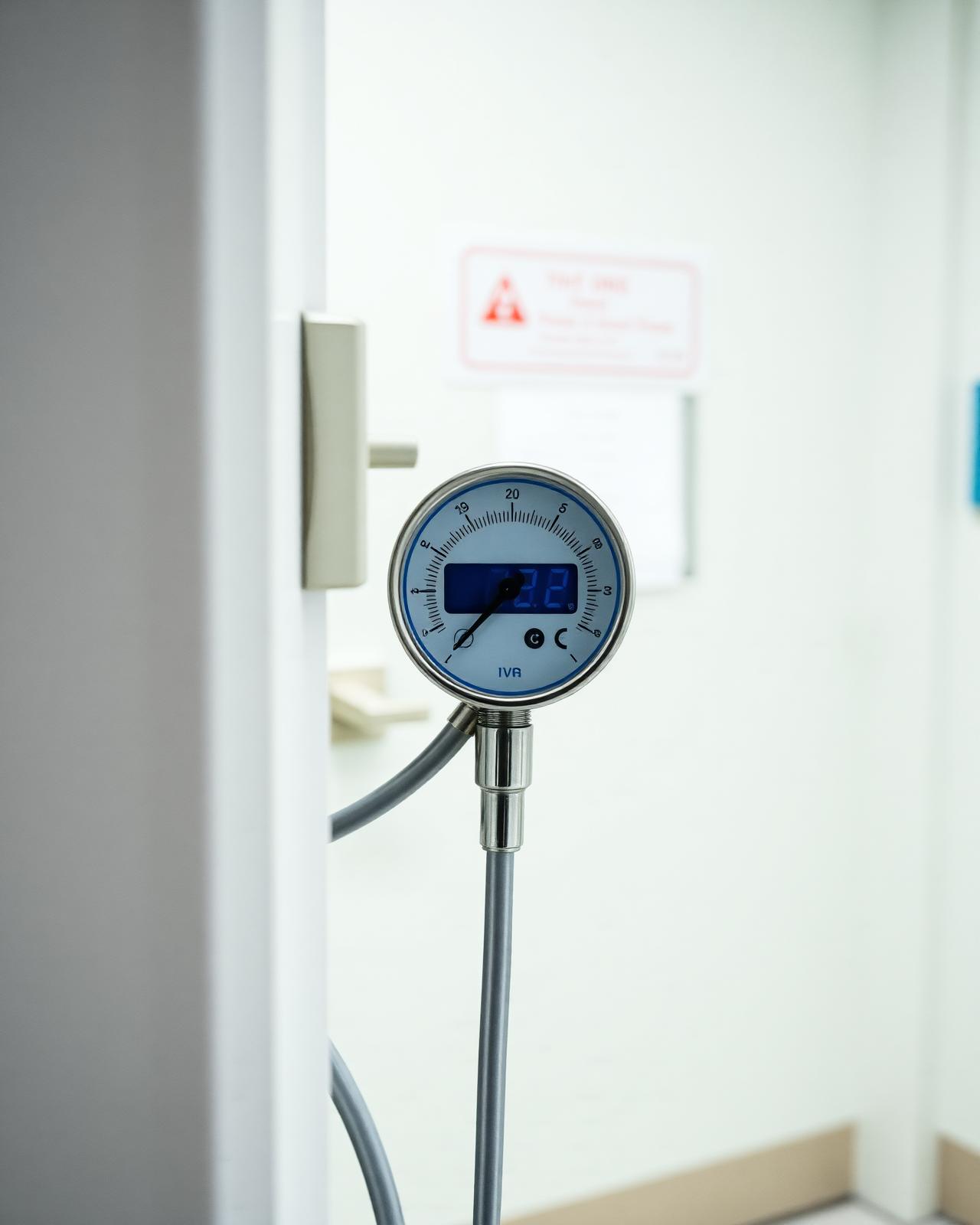
Negative vs positive pressure rooms
Negative pressure rooms — typically airborne isolation — pull air inwards so any contamination released by the patient is contained and extracted to outside. Positive pressure rooms — protective isolation, theatres, sterile preparation — push filtered air outwards to keep contaminants out. HTM 03-01 sets expected differentials, typically in the order of 5–15 Pa depending on application.
How we test pressure regimes
Engineers deploy calibrated micromanometers across each critical doorway, record steady-state differentials, then capture transient behaviour as doors are opened, closed and held. We confirm both magnitude and direction, and cross-check against the BMS reading where one is fitted.
Common failure modes
We routinely find rooms that pass static checks but lose pressure when adjacent doors are opened, BMS sensors that have drifted out of calibration, and rooms where the supply/extract balance has been adjusted for comfort and inadvertently inverted a critical pressure cascade. All non-conformities are reported against HTM 03-01 with clinical risk context.
What's included
- Calibrated micromanometer readings at every critical doorway
- Static and transient pressure behaviour
- BMS sensor cross-check
- HTM 03-01 conformity statement per room
Next step
Talk to a healthcare air quality specialist
Independent technical support for hospital ventilation, HTM 03-01 compliance, environmental monitoring and infection control air quality.